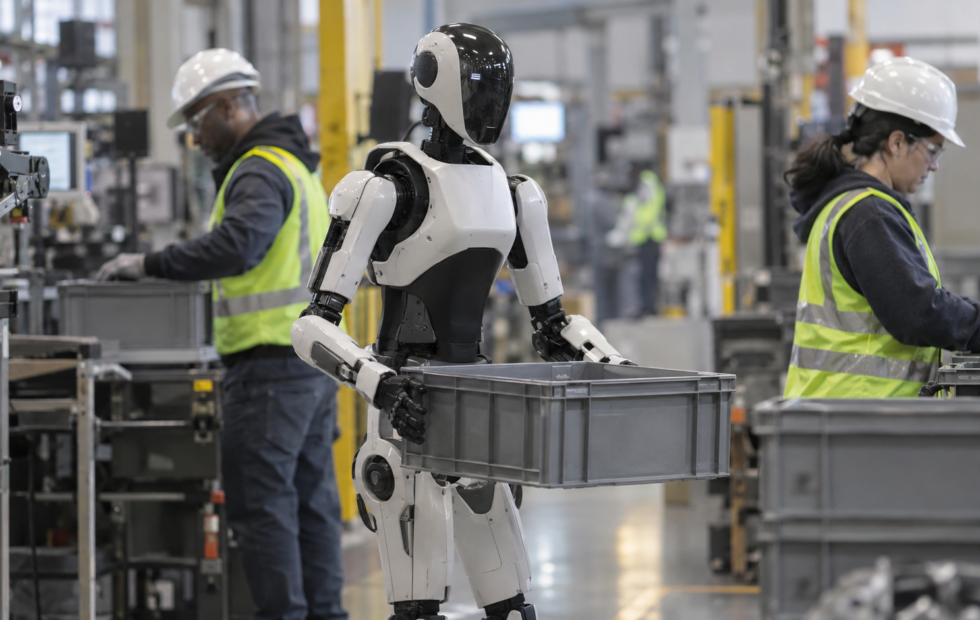
Humanoid robots are beginning to move beyond flashy demonstrations and controlled laboratory experiments. In 2026, a growing number of machines designed to resemble and move like humans are being tested—and in some cases already working—inside factories and warehouses.
For years, humanoid robots were best known for viral videos showing machines walking, running, dancing, or performing impressive acrobatics.
But the industry’s attention is increasingly shifting toward a much harder question: Can these robots perform useful work reliably enough to justify their cost?
Recent developments suggest that the answer is slowly moving toward yes, although the technology remains far from replacing human workers on a large scale.
BMW, Hyundai, GXO Logistics, Mercedes-Benz and several major technology companies are now experimenting with humanoid robots for manufacturing, material handling and other repetitive physical tasks.
BMW Is Already Testing Humanoid Robots on Production Lines
One of the clearest examples comes from BMW.
At the automaker’s Spartanburg plant in South Carolina, Figure AI’s Figure 02 humanoid robot participated in a production deployment involving BMW X3 vehicles.
According to BMW, Figure 02 supported the production of more than 30,000 BMW X3 vehicles during a ten-month deployment.
The robot handled more than 90,000 components, accumulated approximately 1,250 operating hours, and walked roughly 1.2 million steps while performing production tasks.
Its main task involved retrieving sheet-metal components and positioning them accurately for the welding process.
That may sound relatively simple compared with the futuristic idea of a general-purpose robot worker, but this type of repetitive industrial task is exactly where humanoid robotics could initially become useful.
BMW said the project demonstrated that humanoid robots could perform repetitive positioning tasks with millimeter-level accuracy under real production conditions.
The company has since continued developing its physical AI strategy.
In June 2026, BMW announced another project involving the newer Figure 03 robot at its Spartanburg facility.
Humanoid Robots Are Also Entering BMW’s German Factories
BMW’s experiments are no longer limited to the United States.
In 2026, the automaker introduced a humanoid robot called AEON at its Leipzig plant in Germany.
The robot, developed by Hexagon Robotics, is being tested for manufacturing applications including battery and component production.
AEON can move around the factory, transport materials and operate using interchangeable tools or grippers.
BMW describes the technology as part of its broader push into physical AI—the combination of artificial intelligence with machines capable of interacting with the physical world.
The important distinction is that these robots are not simply generating information like traditional AI systems.
They are using AI to perceive environments, make decisions and physically interact with objects.
Warehouse Robots Are Already Doing Commercial Work
Manufacturing is not the only industry experimenting with humanoids.
Warehouses may prove to be one of the most practical early markets.
GXO Logistics signed a multi-year agreement with Agility Robotics to deploy the company’s Digit humanoid robot in warehouse operations.
Digit has been used at a GXO-operated facility in Georgia to move containers from autonomous mobile robots and place them onto conveyor systems.
Agility Robotics says Digit has now moved more than 100,000 totes during its commercial deployment at the facility.
This is important because it represents something different from a technology demonstration.
The robot is performing repetitive tasks inside an operating logistics environment.
GXO has described its agreement with Agility as an early commercial deployment of humanoid robotics and has said it sees potential for humanoids to eventually operate across a wider range of warehouse tasks.
Boston Dynamics Is Turning Atlas Into a Commercial Product
Another major name entering the industrial humanoid race is Boston Dynamics.
For years, its Atlas robot became famous for videos demonstrating sophisticated movements, including jumping and complex mobility.
The latest version has a much more practical purpose.
At CES 2026, Boston Dynamics unveiled a production version of the electric Atlas humanoid and announced that manufacturing had begun.
The company said its 2026 deployments were already committed, with robots scheduled for Hyundai’s Robotics Metaplant Application Center and Google DeepMind.
Boston Dynamics says Atlas is being developed for industrial applications including:
- part sequencing,
- machine tending,
- order building,
- material handling,
- and other factory tasks.
The robot has already entered Hyundai facilities for field testing involving real-world sequencing tasks.
The change illustrates how the humanoid robotics industry is evolving.
The impressive movements that once attracted public attention are increasingly becoming secondary to reliability, safety and productivity.
Why Build Robots That Look Like Humans?
Humanoid robots are significantly more complicated than traditional industrial machines.
That raises an obvious question: why give robots two arms, legs and a human-like body at all?
The answer largely comes down to infrastructure.
Factories, warehouses, tools, doors, shelves, stairs and workstations have been designed around human bodies.
Traditional industrial robots often require specialized environments.
A humanoid robot could theoretically enter spaces originally designed for people without requiring companies to completely redesign their facilities.
For example, it could potentially walk between workstations, reach shelves designed for human arms, carry containers and operate equipment built for human workers.
This versatility is one of the main arguments behind the enormous investment flowing into humanoid robotics.
AI Is Becoming the Robot’s Brain
Mechanical engineering is only one part of the challenge.
Modern humanoid robots also require increasingly sophisticated artificial intelligence.
A factory robot traditionally performs carefully programmed movements in highly predictable environments.
A general-purpose humanoid needs to do considerably more.
It must understand its surroundings, identify objects, maintain balance, determine how objects should be manipulated and respond when something unexpected happens.
This is where recent developments in AI are becoming important.
Large AI models, computer vision, reinforcement learning and simulation are being combined to create what the industry increasingly calls embodied AI or physical AI.
Instead of AI simply producing text, images or software, physical AI allows machines to convert artificial intelligence into actions in the real world.
But Humanoid Robots Still Have Major Limitations
Despite the rapid progress, claims that humanoid robots are about to replace millions of human workers should be treated cautiously.
The gap between a controlled demonstration and dependable everyday work remains significant.
Robots still struggle with many tasks that humans perform almost effortlessly.
Picking up unfamiliar objects, working in messy environments, responding to unexpected situations and manipulating small components can all be difficult.
Reuters reported in August 2026 that even China’s rapidly expanding humanoid robotics industry continues to face challenges involving dexterity, intelligence, reliability and commercial usefulness. Many machines remain slower and less adaptable than conventional industrial robots for specific factory tasks.
The Financial Times has similarly noted that purpose-built industrial robots remain significantly more important to today’s manufacturing economy than humanoids, particularly in China, where millions of conventional industrial robots are already operating.
This means humanoid robots still need to prove that their flexibility can outweigh their additional complexity and cost.
Reliability May Matter More Than Impressive Demonstrations
A robot doing a backflip makes an entertaining video.
A robot successfully moving components thousands of times without interruption is far more valuable to a factory operator.
That distinction is becoming increasingly important.
Industrial customers care about metrics such as:
- uptime,
- operating cost,
- accuracy,
- speed,
- maintenance,
- battery life,
- worker safety,
- and return on investment.
A humanoid robot that performs dozens of tasks unreliably may be less useful than a conventional machine that performs one task extremely well.
For humanoids to become mainstream, developers will need to demonstrate that they can deliver consistent economic value.
What Happens to Human Jobs?
As humanoid robots improve, concerns about employment will inevitably grow.
Manufacturers developing the technology generally emphasize tasks that are repetitive, physically demanding or potentially hazardous.
BMW, for example, says its strategy is aimed at allowing robots to take over repetitive or physically stressful work while human employees focus on tasks requiring judgment, experience and creativity.
GXO has made similar arguments about using humanoid robots to reduce repetitive lifting and allow workers to move toward higher-value activities.
However, the longer-term impact is difficult to predict.
If humanoids eventually become reliable and inexpensive enough to perform many different tasks, some jobs could undoubtedly become automated.
At the same time, new roles are likely to emerge around robot maintenance, supervision, training, fleet management and AI systems.
The transition could therefore change the nature of industrial work rather than simply eliminating it.
China Is Racing Toward Commercial Humanoids
China has also emerged as one of the world’s most aggressive humanoid robotics markets.
At the 2026 World Robot Conference in Beijing, hundreds of companies presented robotics technology, with humanoid machines demonstrating tasks including parcel sorting, phone assembly and household activities.
Several Chinese developers are already testing robots in logistics and manufacturing environments.
However, industry leaders are increasingly emphasizing that the next stage must focus on economic usefulness rather than impressive demonstrations.
The commercial test is simple: companies need robots that can work reliably enough to generate a return on investment.
2026 Could Be a Turning Point
Humanoid robots have not taken over factories.
They are not yet capable of performing every task that human workers can handle.
And many demonstrations still happen under carefully controlled conditions.
Nevertheless, 2026 represents an important stage in the technology’s evolution.
BMW has accumulated thousands of hours of real-world experience.
Digit is working commercially in logistics.
Boston Dynamics is manufacturing its production version of Atlas.
Other companies are collecting enormous amounts of real-world data to train the next generation of physical AI systems.
These developments suggest humanoid robotics is beginning to move from “Can we build it?” toward a much more important question:
“Can it actually work?”
The Bottom Line
Humanoid robots are moving closer to real-world jobs, but the transition will probably be gradual rather than sudden.
Their first successful roles are likely to involve predictable, repetitive and physically demanding work in structured environments such as factories and warehouses.
Humans remain far more adaptable when tasks require judgment, improvisation, communication or complex fine motor skills.
But each production deployment gives robotics companies something extremely valuable: real-world experience and data.
The more these machines work, the more developers can learn about where they fail and how to improve them.
That learning cycle could determine whether humanoid robots remain specialized industrial experiments—or eventually become one of the most significant changes to the global workforce since the arrival of modern industrial automation.