The AI Boom Has a Long Supply Chain
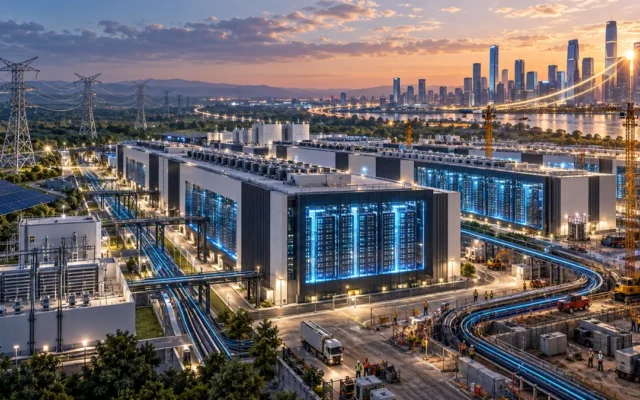
When investors hear “AI infrastructure,” attention often goes straight to the biggest chip companies. But a data center is a stack of interconnected businesses, and money flows through nearly every layer.
The obvious beneficiaries are accelerator designers and memory suppliers. Yet servers also need high-speed switches, optical links, storage, power conversion, cooling, racks, backup systems, buildings, land, and electricity. The result is a broad capital-spending cycle in which companies that never trained an AI model can still earn substantial revenue from the boom.
Servers, Networking and Memory
Server manufacturers are among the clearest near-term winners because cloud providers need complete systems, not isolated chips. Dell said in September 2026 that it had received more than $130 billion in AI server orders over the previous year and raised its annual outlook again.
Networking is equally important. Thousands of accelerators must communicate with extremely low latency. That increases demand for specialized switches, interconnects, optical components, and networking software. Memory suppliers also benefit because advanced AI systems require large amounts of high-bandwidth memory and storage.
Power and Cooling Are Becoming Technology Businesses
The economics of AI increasingly depend on watts as much as processors. Companies that can provide transformers, switchgear, backup power, grid connections, liquid cooling, heat exchangers, and energy management may capture a growing share of infrastructure spending.
This is one reason energy developers are being pulled closer to the technology sector. Large campuses may sign long-term power agreements or support new generation projects. Investors are also watching businesses that can shorten the time between site selection and usable megawatts.
Construction, Real Estate and Finance
Data center construction requires specialized contractors, engineering firms, electrical installers, and real-estate developers. Land near transmission infrastructure and fiber routes can become strategically valuable.
Finance is another major layer. AI campuses can cost billions before producing meaningful cash flow. That creates demand for project finance, private credit, infrastructure funds, structured leases, and public-market capital. Companies such as Nscale are seeking large funding packages as they expand GPU-based capacity, demonstrating how capital markets are becoming part of the infrastructure race.
Who Carries the Most Risk?
Not every participant will win. Hardware prices can fall, technologies can change, and some projects may be built on overly optimistic assumptions about future AI demand. Power constraints can delay projects, while financing becomes harder when interest rates rise.
The most durable businesses may be those that solve unavoidable bottlenecks rather than relying on a single generation of hardware. Electricity, networking, cooling, and data-center operations remain necessary even as specific AI models and chips evolve.
The AI infrastructure boom is therefore broader than a chip story. It is an industrial supply-chain story—and that is why so many different companies are competing for a piece of it.
Conclusion
Business conditions are changing quickly, but the central lesson is consistent: companies that understand the underlying economics, measure real outcomes, and adapt faster than competitors are better positioned to turn uncertainty into opportunity.