A Data Center Is No Longer Just a Server Building
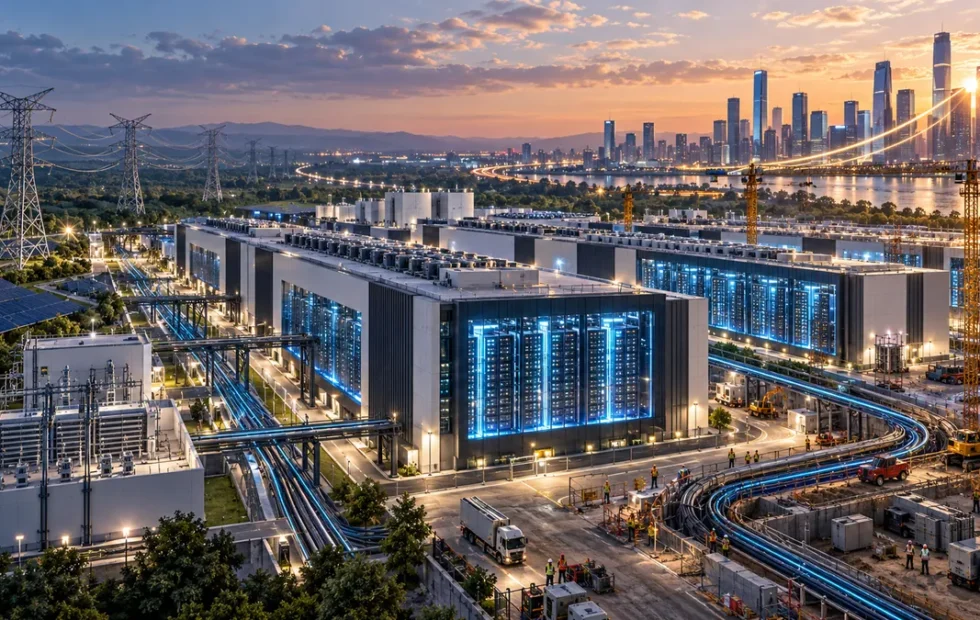
The modern AI data center is becoming an industrial project on the scale of a power plant, logistics hub, or advanced manufacturing complex. It requires land, grid connections, substations, fiber networks, cooling systems, specialized construction, and enormous quantities of computing equipment.
That makes AI infrastructure economically important far beyond the technology sector. Every large project creates spending across engineering, construction, utilities, equipment suppliers, chipmakers, networking vendors, and local services. In regions competing for investment, data center campuses are increasingly treated as strategic economic-development assets.
The Capital Spending Multiplier
AI workloads require dense clusters of accelerators, high-speed networking, and large amounts of memory. Building that capacity means billions of dollars can flow through multiple layers of the supply chain before a model serves its first customer.
In September 2026, a TCS subsidiary and partners announced plans to invest up to roughly $7.4 billion in a 1-gigawatt AI data center campus in Telangana, India. Projects of that size illustrate why governments and investors now view AI infrastructure as a form of industrial capital expenditure rather than simply an IT budget item.
The spending does not stop with the building. Facilities require long-term electricity procurement, maintenance, security, operations staff, replacement hardware, and continuous network upgrades.
Power Is Becoming Part of the AI Economy
The most important constraint may be electricity. AI servers use far more power per rack than traditional enterprise servers, while advanced cooling systems add another infrastructure layer. As a result, data center growth is pulling utilities, renewable-energy developers, battery-storage providers, grid-equipment makers, and gas-power projects into the AI investment cycle.
This can stimulate investment in transmission and generation, but it can also create tension. Communities may question who pays for grid upgrades, how water is used, and whether industrial power demand raises costs for households. Economic growth therefore depends on infrastructure planning, not simply on approving more server buildings.
Regional Winners Will Need More Than Cheap Land
The most attractive locations combine reliable power, fast permitting, fiber connectivity, political stability, technical talent, and access to customers. Cheap land alone is not enough.
Countries and states that solve these infrastructure bottlenecks can attract related businesses. Cloud providers may draw semiconductor packaging, network suppliers, engineering firms, and software companies into the same region. Over time, that can create an ecosystem effect similar to what occurred around ports, automotive clusters, or semiconductor fabs.
The Bigger Economic Question
Data centers can support growth, but policymakers should distinguish between headline investment and durable local value. A facility may be extremely capital-intensive while employing fewer permanent workers than a factory of similar cost.
The strongest economic strategy is therefore to connect data center investment with workforce training, energy development, research institutions, cloud services, and local technology businesses.
AI data centers are becoming a new engine of economic growth because they pull investment into physical infrastructure at unusual scale. The regions that benefit most will be those that turn compute capacity into a broader industrial ecosystem.
Conclusion
Business conditions are changing quickly, but the central lesson is consistent: companies that understand the underlying economics, measure real outcomes, and adapt faster than competitors are better positioned to turn uncertainty into opportunity.