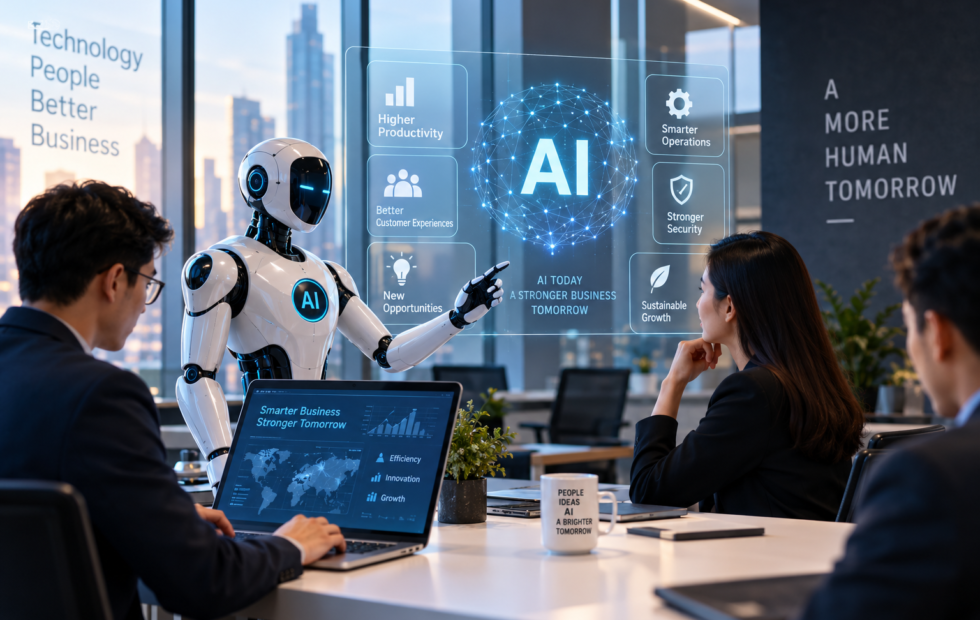
Artificial intelligence is no longer a futuristic technology that companies can afford to observe from the sidelines. In 2026, AI has become an increasingly important part of how businesses operate, compete, communicate with customers, analyze information, and make decisions.
From small businesses using AI-powered customer service tools to multinational corporations deploying autonomous AI agents across complex workflows, the technology is reshaping the modern workplace at remarkable speed.
The biggest change, however, is not simply that businesses are using more AI. Companies are beginning to redesign their operations around it.
McKinsey’s latest global research found that 88% of surveyed organizations were regularly using AI in at least one business function, although many companies were still experimenting rather than deploying AI across the entire organization.
For business leaders, this creates both an opportunity and a challenge. Companies that understand where AI can deliver real value may gain an important competitive advantage, while businesses that adopt AI without a clear strategy could waste money, create security risks, or struggle with regulatory requirements.
AI Is Moving From Experimentation to Everyday Business
During the early generative AI boom, businesses often treated AI as an experimental productivity tool.
Employees used AI to summarize documents, generate marketing copy, brainstorm ideas, write emails, or assist with software development.
In 2026, companies are increasingly looking beyond these basic applications.
Businesses are integrating AI into sales systems, customer support platforms, financial analysis, supply chains, cybersecurity operations, human resources, product development, and internal knowledge management.
One particularly important development is the emergence of AI agents.
Unlike traditional chatbots that typically respond to individual instructions, AI agents can potentially complete multi-step tasks, interact with business systems, analyze information, and take actions based on predefined goals and permissions.
McKinsey reported that 62% of organizations surveyed were at least experimenting with AI agents.
For companies, this could eventually transform AI from a digital assistant into something closer to a digital workforce capable of supporting employees across entire business processes.
Productivity Is Only Part of the Opportunity
Many executives initially invested in AI because of its potential to increase productivity and reduce operating costs.
Those benefits remain important.
AI can help employees process large amounts of information faster, automate repetitive administrative tasks, generate first drafts, analyze customer feedback, assist programmers, and provide faster responses to customers.
However, companies achieving the greatest long-term value from AI are increasingly looking beyond simple cost reduction.
AI can also help organizations create new products, personalize services, identify previously unnoticed market opportunities, accelerate research, and improve decision-making.
McKinsey’s research found that while 80% of respondents said efficiency was an objective of their AI initiatives, organizations reporting higher value were more likely to pursue objectives such as growth and innovation as well.
That distinction matters.
A company asking, “How can AI reduce our expenses?” may discover incremental improvements.
A company asking, “How could AI allow us to operate differently?” may discover an entirely new business model.
AI Will Change Jobs Rather Than Simply Eliminate Them
Perhaps no aspect of artificial intelligence generates more concern than its impact on employment.
Automation will undoubtedly affect certain tasks, particularly repetitive digital activities that can be standardized. But the broader transformation is more complicated than simply replacing human workers with machines.
AI is increasingly changing what employees do.
Marketing professionals may spend less time producing basic first drafts and more time developing strategy.
Software engineers may spend less time writing routine code and more time reviewing architecture and solving complex problems.
Customer service employees may allow AI to handle simple questions while focusing on difficult cases requiring judgment and empathy.
The World Economic Forum reports that 86% of employers expect AI and information-processing technologies to transform their businesses by 2030. It also identified skills shortages as one of the biggest barriers organizations face when adopting AI.
This means employee training could become just as important as investments in AI software.
Companies may need workers who understand not only how to use AI tools, but also how to evaluate their output, protect sensitive information, recognize errors, and determine when human intervention is necessary.
Proprietary Data Is Becoming a Competitive Advantage
Powerful AI models may be available to thousands of companies, but every organization possesses something competitors cannot easily replicate: its own business data.
Customer history, internal documentation, product information, operational records, technical knowledge, research, and organizational experience can dramatically increase the usefulness of AI when managed correctly.
IBM’s research has highlighted the growing importance executives place on proprietary data and integrated enterprise data architecture for unlocking value from AI.
Businesses therefore need to think beyond simply purchasing an AI subscription.
They need a strategy for organizing, securing, cleaning, and connecting their information.
An advanced AI system connected to inaccurate or poorly managed data can produce inaccurate results faster.
Data quality remains fundamental.
Cybersecurity and AI Governance Cannot Be Ignored
As companies give AI greater access to corporate information and business systems, security becomes increasingly important.
Organizations must determine which information employees can share with external AI services, which models are approved, what data can be stored, and what actions automated systems are permitted to perform.
AI can introduce risks involving confidential information, hallucinated answers, biased decisions, unauthorized system access, intellectual property, and malicious manipulation.
Companies deploying AI therefore need governance policies covering areas such as:
- Data privacy
- Human oversight
- Access permissions
- Cybersecurity
- Model evaluation
- AI-generated content
- Accuracy requirements
- Vendor management
- Regulatory compliance
This is particularly important for organizations using AI in sensitive areas such as finance, healthcare, recruitment, legal services, and critical infrastructure.
AI Regulation Is Becoming a Business Issue
Regulation is another reason companies can no longer treat AI as merely an IT experiment.
The European Union’s AI Act entered a major enforcement phase on August 2, 2026. Among other requirements, transparency rules now apply to certain AI systems and AI-generated or manipulated content.
Companies operating internationally may therefore face different AI requirements depending on where customers, employees, and services are located.
This makes compliance an increasingly important part of AI strategy.
Businesses should understand what AI systems they are using, where their data is processed, which vendors provide the technology, and whether particular applications fall under regulated categories.
Creating an internal inventory of AI systems may become as normal as maintaining cybersecurity or software asset records.
The Companies That Win Will Redesign Their Workflows
One of the biggest mistakes businesses can make in 2026 is adding AI to inefficient processes without changing the processes themselves.
Imagine a company with a complicated approval process involving several spreadsheets, emails, databases, and manual reviews.
Adding an AI assistant might make one part of that process slightly faster.
Redesigning the entire workflow around automation, structured data, AI assistance, and appropriate human approval could produce significantly greater improvements.
This is why AI transformation increasingly involves organizational design rather than simply technology deployment.
Businesses should identify high-value workflows, measure their current performance, determine where AI can improve them, test carefully, and then evaluate measurable results.
What Companies Should Do in 2026
Companies do not need to implement AI everywhere immediately.
They need to implement it intelligently.
The most practical strategy is to identify a small number of high-impact opportunities where AI can improve revenue, productivity, customer experience, or decision-making.
Businesses should then build the supporting infrastructure: reliable data, cybersecurity controls, employee training, governance policies, and measurable performance indicators.
Human oversight should remain an important part of critical decisions.
Companies should also regularly reassess their AI strategy because the technology is evolving rapidly.
The Bottom Line
Artificial intelligence is becoming part of the basic infrastructure of modern business.
The competitive question is shifting from whether companies should use AI to how effectively they can integrate AI into their organizations.
Companies that simply purchase AI tools may achieve temporary productivity gains. Businesses that combine AI with better workflows, strong data, trained employees, security, governance, and a clear business strategy have the potential to achieve something much more significant.
In 2026, AI transformation is no longer primarily about experimenting with technology.
It is about redesigning how businesses work—and companies that recognize that distinction may be best positioned for the next stage of the digital economy.